
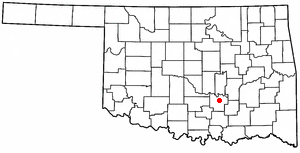


In the late 1880s, the Daggs family (by way of Texas) became the first white family to settle what is now known as Ada, which was formerly known as Daggs Prairie. In April 1889, Jeff Reed (a Texan and relative of the Daggs family) was appointed to carry the mail from Stonewall to Center (which was later combined with Pickett), two small communities in then Indian Territory. With his family and his stock, he sought a place for a home on a prairie midway between the two points, where he constructed a log house and started Reed's Store. Other settlers soon built homes nearby. In 1891, a post office was established and named after Reed's oldest daughter, Ada. Ada incorporated as a city in 1901 and grew rapidly with the arrival of the St. Louis and San Francisco Railway line. Within a decade the Santa Fe Railroad and the Oklahoma Central Railway also served the town.
Ada was originally a sundown town, where African Americans were not allowed to live. In the 1900s, the town was opened up to African Americans so that black witnesses could stay while testifying in district court. Ada began allowing Black people to open restaurants, barber shops, stores, and hotels by court order as to offer places where "negro witnesses might stay during the [court] session". Unnamed individuals threatened them, writing that "unless they left the town immediately they must suffer the consequences." When the threats went unanswered, unnamed parties blew up a Black restaurant with dynamite, seriously injuring one occupant. According to the Arkansas City Daily Traveler article, published on March 30, 1904, "This action has been condemned by many citizens and a reward has been offered for arrest of the guilty parties...most citizens now believe negroes should be allowed to live there." After the incident, the town remained open to African Americans to provide labor for a local cotton compress.
In 1909, the women of Ada organized an effort to build a normal school in their city. It resulted in the founding of East Central College (now East Central University).
On April 19, 1909, an organized mob hanged four men, among whom was American outlaw Deacon Jim Miller, who was set to be tried for the murder of a former U.S. marshal and member of the local freemason lodge. The town had a population of about 5,000 at the time, and 38 murders a year at the time of the lynching. The Daily Ardmoreite reported that the four lynched men were "one of the bloodiest band of murderers in the state of Oklahoma and an organization of professional assassins, that for a record of blood crimes, probably has no equal in the annals of criminal history in the entire southwest".